If you’ve ever tried to explain to a compliance officer why your sensitive workloads are sitting on a shared hypervisor somewhere in an undisclosed data centre, you’ll know the conversation doesn’t go well. For European IT teams navigating GDPR, NIS2, and sector-specific regulations like PSD2 or MDR, infrastructure decisions have become genuinely high-stakes — not just a matter of performance or cost.
The good news is that the choice isn’t binary anymore. You don’t have to pick between raw performance and operational convenience. But you do need to understand what each infrastructure tier actually gives you — and what it quietly takes away.
Let’s walk through the real trade-offs between bare metal, VPS, and managed cloud, specifically through the lens of regulated workloads in Europe.
Why infrastructure tier matters more for regulated workloads
Most infrastructure comparisons focus on price-per-vCPU or uptime SLAs. That’s fine for a startup running a marketing site. But when you’re handling patient records, financial transactions, or personally identifiable data under GDPR, the questions shift considerably.
You start asking things like: Who else is running on this hardware? Where exactly is my data processed? Can I prove to an auditor that no unauthorised party has physical access to my environment? These aren’t paranoid questions — they’re requirements.
European cloud infrastructure has matured enormously over the past few years, partly driven by regulatory pressure and partly by genuine market demand for data sovereignty. The hyperscalers have responded with EU-specific regions and compliance certifications, but there’s still a meaningful gap between technically compliant and operationally sovereign.
Bare metal: maximum control, maximum responsibility
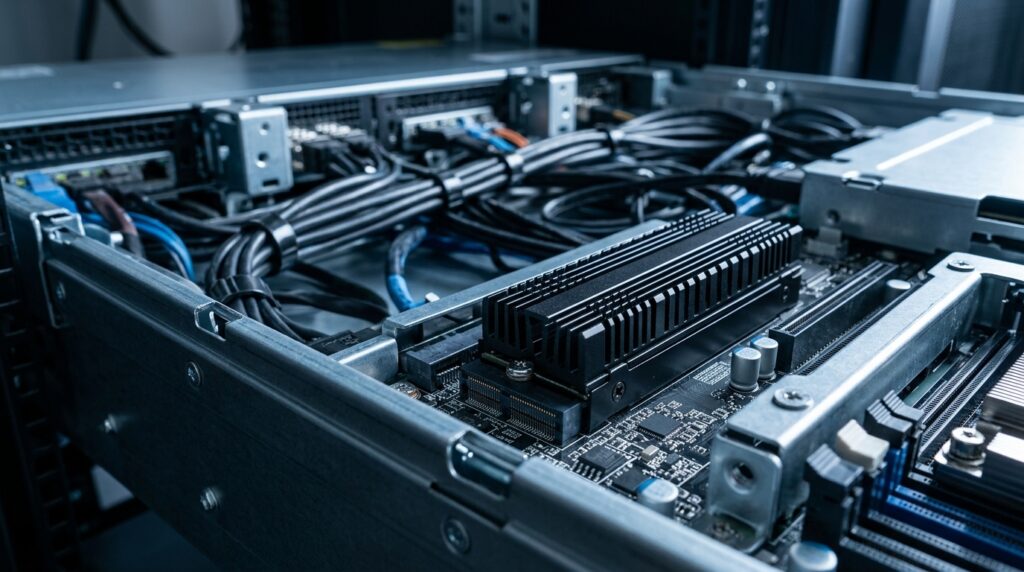
A dedicated server gives you exactly what it sounds like — a physical machine that no one else is using. No noisy neighbours, no shared kernel, no hypervisor overhead. For workloads that demand consistent, predictable performance — think high-frequency trading systems, large database clusters, or compute-intensive analytics — bare metal is often the only honest answer.
From a compliance perspective, bare metal hosting is also the cleanest story to tell. You can demonstrate physical isolation, control your own encryption keys at the hardware level, and in many cases choose a data centre within a specific EU jurisdiction. That matters when your DPA asks where data is processed.
Key takeaway: Bare metal doesn’t just improve performance — it simplifies your compliance narrative. Physical isolation is the one guarantee no virtualised environment can fully replicate.
The trade-off is operational overhead. You own the configuration, the patching cadence, the security hardening. Scaling isn’t instant — provisioning a new dedicated server takes time. For teams with strong internal DevOps capability, that’s manageable. For smaller organisations, it can become a liability.
VPS: the pragmatic middle ground
A virtual private server sits between shared hosting and dedicated infrastructure. You get your own isolated environment — dedicated resources, root access, a consistent allocation of CPU and RAM — without the cost or commitment of physical hardware.
For many regulated workloads, a well-configured VPS on European infrastructure is entirely sufficient. The key word there is well-configured. VPS environments vary enormously in quality depending on the underlying hypervisor, the density of co-tenants on the host, and how the provider handles network isolation.
When evaluating a VPS for GDPR compliant hosting, the questions to ask your provider are surprisingly specific: What hypervisor technology are you using? Are resources guaranteed or burstable? Where is the physical host located, and under which legal jurisdiction? A provider who can’t answer those questions clearly is probably not the right partner for sensitive workloads.
VPS infrastructure tends to work well for development and staging environments, lower-traffic production applications, and scenarios where you need European data residency but don’t have the budget or team size to justify dedicated hardware.
Managed cloud: operational convenience with caveats
Managed cloud services — where the provider handles patching, monitoring, backups, and often application-layer management — are genuinely attractive for teams that want to focus on their product rather than their infrastructure. The operational burden shifts significantly.
But convenience comes with trade-offs that matter in regulated contexts. Managed environments often involve shared tooling, third-party integrations, and support staff who may have access to your environment for operational purposes. That’s not inherently problematic, but it needs to be documented, contractually bounded, and understood by your data protection officer.
The dedicated server vs. cloud debate often gets framed as performance versus flexibility, but in regulated industries the real tension is between operational independence and operational convenience. Managed cloud can deliver both — but only if your provider is transparent about where data flows, who has access, and how incidents are handled.
How to think about the decision for your organisation
There’s no universal right answer here, but there are some useful heuristics. Consider bare metal when you have consistent, high-throughput workloads, strict audit requirements, or data that genuinely cannot be co-located with other tenants. Consider a VPS when you need European data residency, reasonable isolation, and predictable costs without the overhead of managing physical hardware. Consider managed cloud when your team’s bandwidth is the bottleneck and you have a provider you trust to handle compliance documentation alongside operations.
Many mature organisations end up running a hybrid of all three — bare metal for core databases and sensitive processing, VPS for application tiers and internal tooling, and managed services for monitoring, backups, or disaster recovery. That’s not architectural indecision; it’s matching infrastructure to workload characteristics, which is exactly what good engineering looks like.
- Bare metal: Best for high-performance, audit-sensitive, or physically isolated workloads
- VPS: Best for cost-effective European data residency with reasonable isolation
- Managed cloud: Best for teams optimising for operational efficiency over raw control
The sovereignty dimension
One thing worth saying plainly: the conversation about European cloud infrastructure has changed. The Schrems II ruling, the EU Data Act, and ongoing geopolitical uncertainty have made data sovereignty a real operational concern — not just a talking point.
Choosing a European provider who operates their own infrastructure, rather than reselling capacity from a US hyperscaler, gives you a fundamentally different risk profile. You know which legal framework governs your data. You know who can be compelled to hand it over. That clarity is worth something — often quite a lot, depending on your sector.
The best infrastructure decisions aren’t just technical — they’re strategic. Understanding the full stack of trade-offs between bare metal, VPS, and managed services puts you in a position to make those decisions confidently, rather than defaulting to whatever’s easiest to procure.
If you’re working through these questions for your organisation, DIVERSITY’s infrastructure portfolio covers all three tiers — purpose-built for European teams who need performance, compliance, and genuine operational independence. It’s worth having a conversation about what your workloads actually need, rather than what the default cloud sales pitch assumes they do.