The short answer is yes, and the gap is wider than most VM-centric architects expect. For the majority of web applications, the performance difference between bare metal and a well-chosen cloud VM is 2–5% and effectively invisible to end users. But that comfortable average hides the tail: for AI inference, real-time event processing, and financial trading, the workloads where latency is the product, the architectural gap between dedicated server performance and virtualised infrastructure is measurable, compounding, and in some cases decisive.
This post works through the mechanics of that gap, the cases where modern hypervisors genuinely close it, and the network dimension that benchmark comparisons almost always underweight.
Where the overhead actually comes from
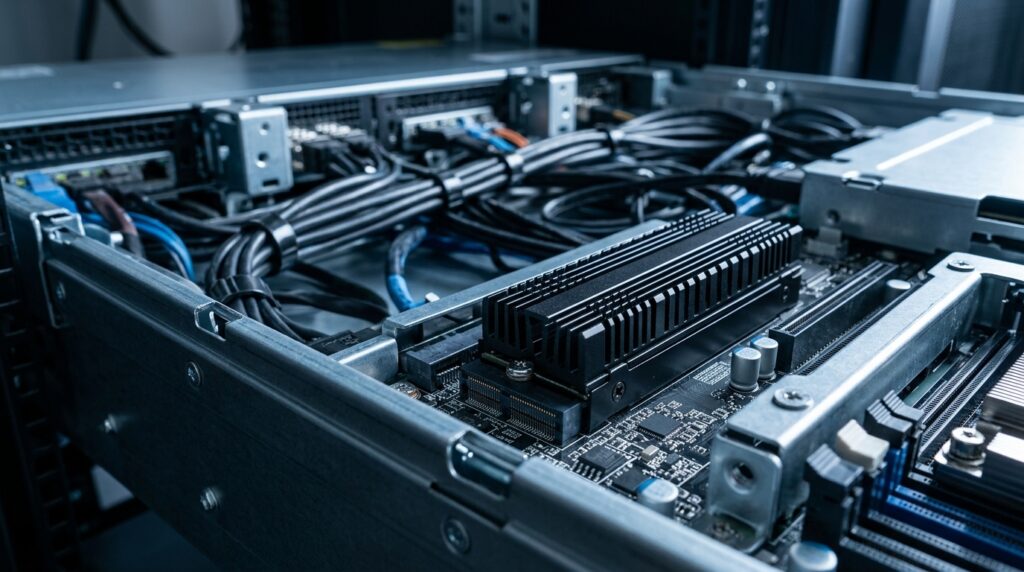
A bare metal server hands your application direct access to every CPU cycle, every cache line, every NVMe queue depth. A VM does not. The hypervisor layer consumes 5–10% of physical host resources before your workload runs a single instruction. That is not a configuration problem or a cloud provider shortcut; it is the structural cost of partitioning hardware between tenants.
The second cost is less predictable: the noisy neighbour. On a shared cloud host, another tenant’s spike can monopolise CPU cache and memory bandwidth, producing steal time. On a lightly loaded host you might see 0–2% steal. Under contention during peak hours, 10–30% steal is not unusual, meaning your application believes it has a full CPU allocation while actually receiving 70–90% of it. For a latency-sensitive API or database, steal time translates directly into added response time: a 10ms query with 15% steal takes 11.5ms, and p99 latency spikes disproportionately because steal is not evenly distributed across time.
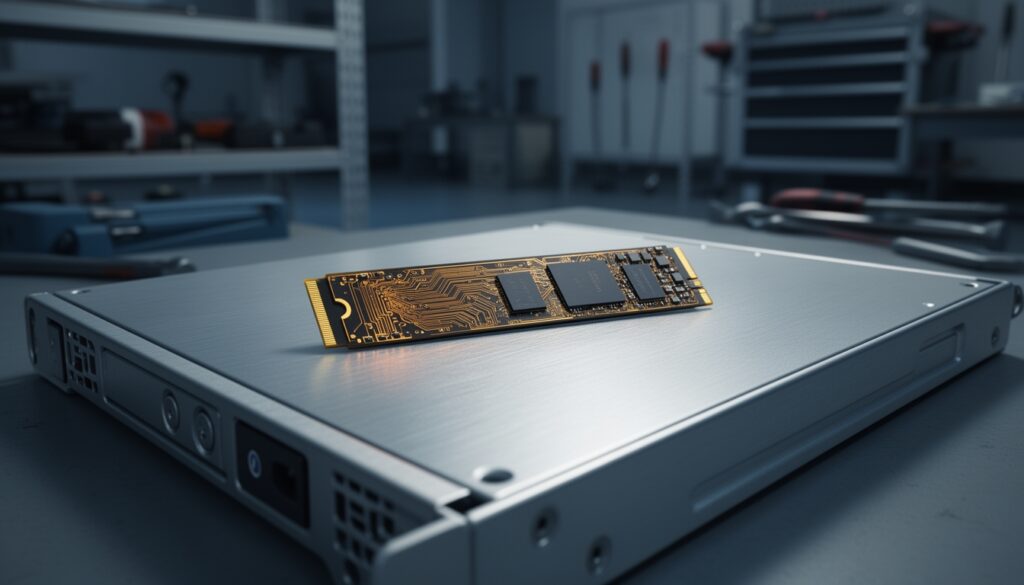
Storage is where the numbers become concrete. Bare metal with local NVMe runs block I/O at 50–100 microseconds. Cloud VMs backed by network-attached storage (AWS EBS, Google Persistent Disk, Azure Managed Disks) add 0.5–2ms per I/O operation just to traverse the internal storage network, putting typical latency at 200–500 microseconds. That is a 3–5x difference, and for any workload where query performance compounds across thousands of operations per second, it accumulates into a structural disadvantage.
The counterpoint: hypervisors have improved
It would be intellectually dishonest to ignore the progress. Modern hypervisors, combined with SR-IOV networking and NVMe passthrough, have genuinely narrowed the gap for certain workload shapes. For containerised web services and stateless compute, the overhead is small enough that operational benefits of cloud VMs (instant provisioning, elastic scaling, managed control planes) frequently outweigh a few percentage points of raw throughput.
Claims that virtualised GPU instances can retain up to 99% of bare metal performance for AI/ML workloads circulate in the industry, but the sourcing matters: the figure comes from a vendor-interested publication and does not link to reproducible test conditions. Treat it as a ceiling under ideal, vendor-tuned circumstances, not a baseline you can plan around at production scale.
The performance gap is not a constant; it is a function of your workload’s sensitivity to jitter, I/O latency, and CPU contention. Average throughput is the wrong metric for any system where the p99 is what your users experience.
Where bare metal latency benchmarks pull decisively ahead
Three workload categories consistently show gaps that operational teams cannot engineer around with VM tuning.
AI inference
Enterprises running fraud detection, real-time recommendation engines, or autonomous control systems typically require sub-10ms inference latency. On co-located bare metal GPU infrastructure that target is reliably achievable. On cloud GPU instances at production scale, shared scheduling and multi-tenant network contention introduce variance that SLA-bound workloads cannot absorb. The performance gap between a virtualised GPU instance and a bare metal GPU in terms of Time to First Token can reach 30% under production load conditions.
Real-time event processing
For Kafka-compatible pipelines and stream processing, CPU steal and I/O jitter translate into consumer lag that cascades into downstream systems. Containers on bare metal can show 25–30% better throughput than the same containers on VMs, and Kubernetes cluster latency on bare metal has been measured at roughly 3x lower than on equivalent VM infrastructure. When your event pipeline is the critical path for financial reconciliation or telemetry aggregation, that difference is not academic.
Financial trading and low-latency bare metal hosting
Real-time bidding and algorithmic trading cannot tolerate jitter. Infrastructure teams report jitter spikes of 15–40ms under contention on cloud VMs, compared to sub-5ms variance on bare metal under equivalent load. At p99, cloud latency events cluster around contention periods; bare metal p99 tracks the underlying network round-trip time. When the round-trip time is itself the competitive variable, you need to own the hardware.
The network dimension that benchmarks miss
Raw compute and storage comparisons leave out the factor that often determines real-world latency for distributed workloads: where your server sits in the network topology, and how many hops separate it from your users, your upstream APIs, and your cloud dependencies.
This is where carrier-neutral colocation and point-of-presence density matter as much as the hardware itself. We operate 44 points of presence across Europe and the Middle East, with direct peering to AWS, Azure, GCP, Oracle, and Cloudflare at every site. For a bare metal inference cluster that needs to pull data from an S3-compatible store or push results to an Azure-hosted application tier, that direct peering eliminates a public internet transit hop entirely. The round-trip time improvement from removing a transit hop is typically larger than the improvement from switching instance families within a single cloud provider.
Carrier-neutral sites also mean your traffic is not captive to one network’s routing decisions. When a peering link degrades or a transit provider has a congestion event, a well-connected neutral facility has alternative paths available that a hyperscaler’s own network does not.
How to frame the bare metal vs VPS performance decision in 2026
The right question is not “is bare metal faster?” in the abstract. It is “does my workload’s latency profile require predictable, uncontended hardware, and does my traffic pattern benefit from network proximity to specific peers?” For most CRUD applications and batch workloads, the answer is no, and cloud VMs remain the operationally sensible default. For AI inference at production SLA, high-frequency event pipelines, and trading infrastructure, the answer is almost always yes.
The 2026 position is more nuanced than the 2020 position, because hypervisors have improved and top-tier cloud instance families have closed some gaps. But the structural advantages of bare metal, no hypervisor tax, no noisy neighbour, local NVMe latency, and network placement at a carrier-neutral facility with dense peering, remain real and remain measurable. For the workloads where latency is the product, those advantages are not marginal.