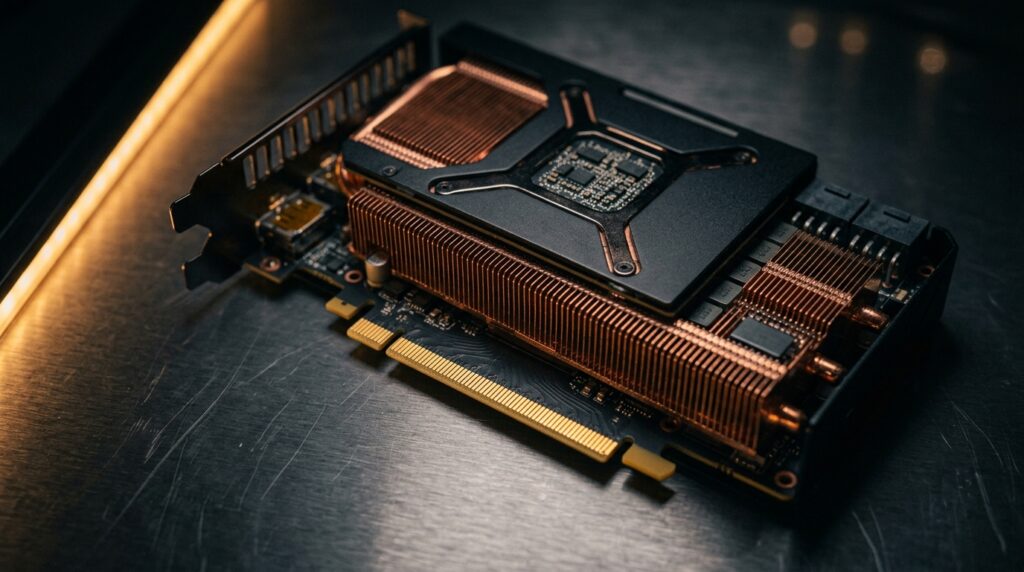
GPU spend is under the microscope. AI coding tools are compressing model deployment cycles from quarters to weeks, and European IT teams are being asked to justify infrastructure decisions that once had the luxury of time. Meanwhile, the Huawei-Nvidia contest in China, where Bernstein forecasts Nvidia’s share of China’s AI chip market falling from roughly 40% to about 8% by end of 2026, is a reminder that the GPU market is not stable. Locking into the wrong provisioning model today compounds the cost of getting it wrong tomorrow. The choice between dedicated GPU inference servers and shared GPU cloud capacity is not a preference: it is a decision with measurable consequences for latency, cost, and contractual sovereignty.
This guide gives you a concrete framework for making that call, grounded in the technical realities of how modern inference workloads actually behave under load.
The bottleneck is memory bandwidth, not compute
Most teams frame the GPU decision around raw compute (FLOPS, tensor core count, generation). The actual bottleneck for large-language-model inference is HBM memory bandwidth. Every forward pass requires moving model weights from GPU memory to compute units; for a 70B parameter model, that is a continuous, bandwidth-hungry operation. NVIDIA rates the H100 SXM5 at 3 TB/s of HBM bandwidth, and exclusive access to that figure is what separates stable P99 latency from variable, unpredictable response times.
In shared GPU environments, tenants compete for access to the same HBM bus. When a neighbouring container initiates a large KV-cache update or triggers a model load, your latency spikes. This is not a theoretical concern: it is the structural consequence of multi-tenancy at the memory layer, and no amount of orchestration fully eliminates it.
For latency-sensitive production serving at scale, bare metal holds a measurable latency advantage, not because the hardware is different, but because the access to that hardware is uncontested.
One benchmark comparison running LLaMA 3 70B at 4-bit quantization on vLLM found bare-metal H100 SXM5 (two-card configuration) delivered P50 latency of 35 ms and P99 of 58 ms at 5,100 tokens per second. The same analysis concluded a 7 to 15% latency advantage for bare metal versus shared cloud endpoints at equivalent throughput. That figure comes from a single vendor-adjacent benchmark without independent replication, so treat the precise percentage as indicative rather than definitive, but the directional conclusion is consistent with what memory contention theory predicts.
Where shared GPU wins: the utilization argument
Shared inference is not wrong. It is wrong for the wrong workload. If your model serves traffic in bursts, sits idle for hours at a time, or is one of several experimental endpoints you are evaluating before committing to production, shared GPU cloud costs look very different from dedicated.
Switching from a dedicated GPU endpoint to a shared multi-model endpoint can cut inference cost per request by 60 to 80% for low-traffic models. At that scale of saving, shared capacity is not a compromise: it is the rational choice. Per-token pricing on managed inference APIs (ranging from roughly $10 to $75 per million output tokens for premium models, depending on the provider) scales linearly with usage, which is exactly what you want when usage is low and unpredictable.
The problem is cold-start latency. Shared and serverless GPU endpoints carry cold-start penalties measured in tens of seconds when a model is not already resident in GPU memory. For internal tooling, batch summarisation, or asynchronous pipelines, that is tolerable. For a customer-facing assistant or a real-time code completion endpoint, it is not.
AI inference latency benchmarks: what the numbers actually mean
When evaluating AI inference latency benchmarks, the metric that matters most for user experience is Time Per Output Token (TPOT), not Time To First Token (TTFT) alone. TTFT dominates perceived responsiveness for short completions; TPOT dominates for anything that streams. Both are affected by memory bandwidth contention in shared environments.
Teams running optimized configurations with TensorRT-LLM on H100 GPUs typically see two to four times throughput improvements versus default serving setups. That gap is worth closing before you decide that dedicated capacity is too expensive: a poorly configured dedicated server and a well-configured shared endpoint can produce similar cost-per-token outcomes at moderate scale, even though the latency profile remains structurally different.
The SemiAnalysis InferenceX benchmarks published in April 2026 put NVIDIA’s GB300 NVL72 at $0.123 per million tokens at 116 tokens per second per user, using Dynamo and TensorRT-LLM. That figure reflects optimized stack conditions on current-generation hardware. It is a useful ceiling for what efficiency looks like; it is not representative of what most teams are running today.
GPU infrastructure cost comparison: hyperscalers vs alternatives
On-demand H100 pricing at the major hyperscalers sits in a wide band. Azure is consistently at the high end, around $11 to $13 per GPU per hour. GCP’s A3 instances run $9 to $11.50. AWS cut P5 prices by 44% in June 2025, bringing the p5.48xlarge (eight H100s) to roughly $55 per hour for the node; verify current list pricing before committing to a budget model, as per-GPU figures vary across sources depending on calculation method and timing.
Specialized providers (Lambda Labs, CoreWeave, RunPod, and comparable operators) offer H100 access at prices 40 to 85% below hyperscaler on-demand rates. B200 availability remains constrained in mid-2026, with most providers offering reservation-only access.
The GPU infrastructure cost comparison that actually matters for European teams, though, is not just price per GPU hour. It is price per GPU hour under the contractual conditions your legal and compliance teams will accept. Hyperscaler shared GPU pools are subject to the US CLOUD Act, which permits US authorities to compel data disclosure from US companies regardless of where that data is physically stored. For workloads processing personal data, financial records, or anything governed by sector-specific regulation, that is not a billing question: it is a legal exposure question.
Sovereignty as a contract-level requirement, not a preference
We operate bare-metal GPU infrastructure across MAD1, MUC1, HEL1, and AMS1, all Tier III, carrier-neutral, ISO 27001-certified facilities with a contractual 99.9% uptime SLA. Single-tenant physical servers mean no hypervisor layer, no neighbouring tenants competing for HBM bandwidth, and no shared scheduling overhead. For teams where sovereignty is a contract-level requirement rather than a marketing consideration, the relevant guarantee is not where the datacenter sits on a map: it is which legal jurisdiction governs the operator, what the contract actually says about data access, and whether the uptime commitment is enforceable.
DORA has been fully enforceable since January 2025, and as of November 2025, AWS, Microsoft Azure, and Google Cloud are among the 19 ICT providers designated as Critical Third-Party Providers under direct supervisory oversight by European financial authorities. That designation does not prohibit their use, but it does impose concentration-risk obligations that make diversification onto infrastructure answering to European law alone a defensible, documented choice rather than a theoretical preference.
A decision framework: matching workload profile to provisioning model
Use shared GPU cloud when: traffic is bursty or unpredictable, the model is experimental or pre-production, cold-start latency is acceptable, and cost minimisation outweighs P99 latency guarantees. Per-token pricing at low utilization is almost always cheaper than amortizing a dedicated node.
Use dedicated GPU inference servers when: you have a latency SLA (internal or contractual) that requires stable P99 performance; you are serving a production model at sustained throughput where the fixed cost amortizes favorably; your workload involves data that cannot legally or contractually traverse US-jurisdiction infrastructure; or you need the full HBM bandwidth for large-model serving without contention.
The hybrid answer is also valid: shared endpoints for experimentation and low-traffic models, dedicated bare metal for the two or three production endpoints where latency and sovereignty actually matter. Most teams running serious inference workloads end up here, not because it is the elegant architecture, but because it matches cost structure to risk profile.
The Huawei-Nvidia dynamic is worth watching for one reason that has nothing to do with China: it is evidence that the GPU market is moving faster than procurement cycles. DeepSeek’s open-sourcing of TileLang-Ascend in September 2025 gives developers a path to writing high-performance workloads on Huawei’s Ascend processors, which matters for European teams evaluating hardware diversity as a long-term risk hedge. Whatever hardware you commit to today, the provisioning model you choose (dedicated or shared, bare metal or managed) should be separable from the specific GPU generation. Lock in the architecture; keep the hardware layer negotiable.